Episode 11: Won't Get Fooled Again

Episode 11 – Won’t Get Fooled Again
This week, Generation FU goes to work.
Back after a fun week on the yacht, Peter looks at what happens when thirty years of experience somehow becomes a liability, every conversation needs its own collaboration platform, and knowing where the button is starts counting for more than knowing whether you should push it.
Then we widen the lens to culture itself—corporate slang, shrinking attention spans, algorithms, “digital natives,” and the uncomfortable realization that the kids didn’t exactly take over. The rest of us just followed them onto the internet.
Along the way: Waiting Room Olympics, the National Endowment for Talking Before Thinking, Organic Dirt, Chronos Minimalist Watches, and a Recharge Recommendation involving the most neglected feature on your smartphone: the phone.
Change is inevitable. Progress is another question.
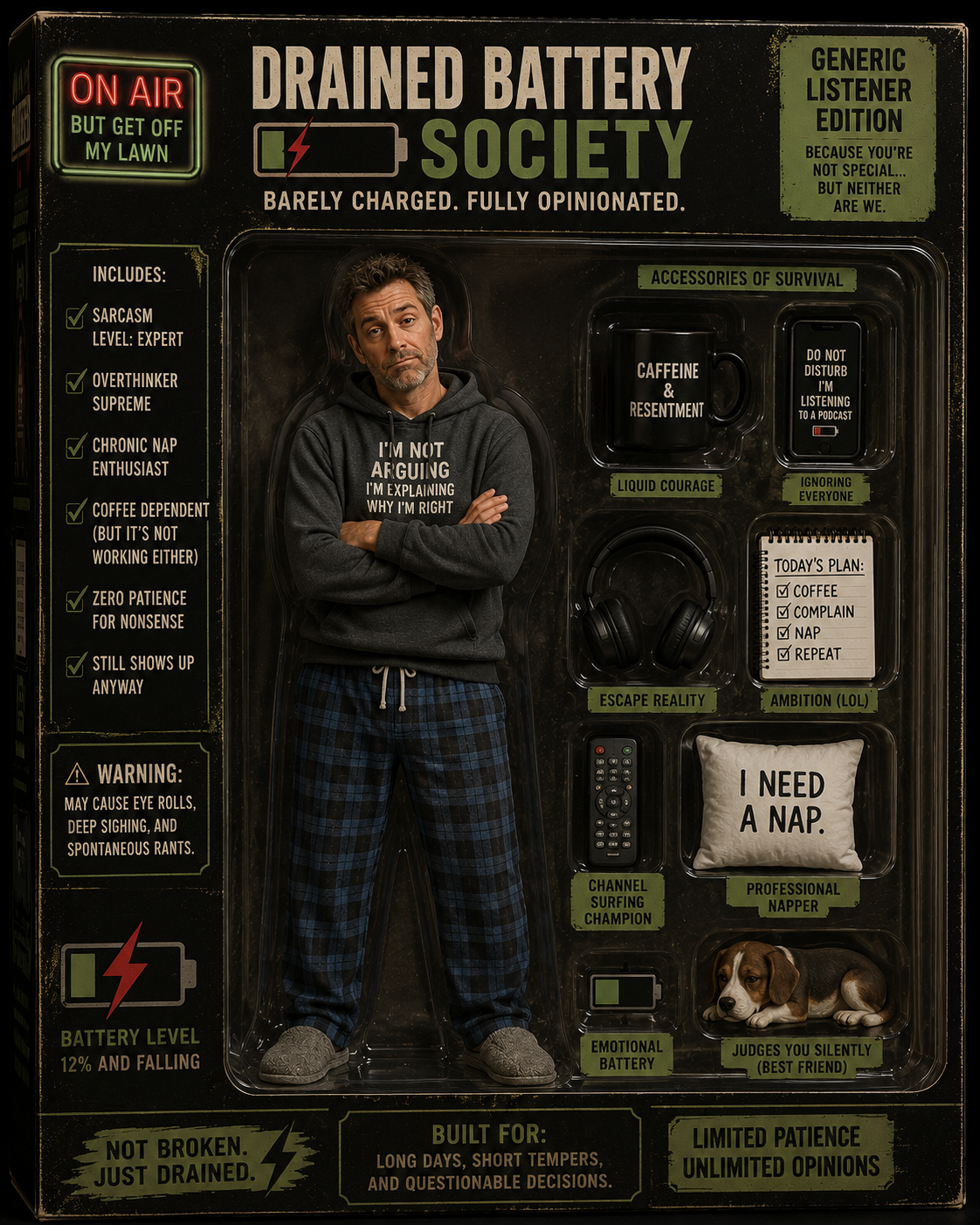
Drained Battery Society.
Barely charged.
Fully opinionated.
A gifted broadcaster. A singular comedic voice. One of the finest hosts working today. Unfortunately, none of them were available this week. So once again, here's the host of Drain Battery Society, Peter Conway.
Cold Open: Waiting Room Olympics
SPEAKER_03I've noticed there's an unspoken competition in every doctor's waiting room. Nobody tells you about it, there isn't a sign, nobody explains the rules, but the minute you sit down, you're in it. The first event is the chair selection. You don't want to sit too close to anybody because then you've accidentally become part of their afternoon. But you also don't want to sit all the way across the room because then it looks like you're avoiding people, which is exactly what you're doing. So you end up choosing a chair that's socially acceptable but still leaves enough room for Jesus between you. Then comes the magazine decision. Nobody actually reads those magazines, they're props. You're not interested in a 12-month-old issue of better homes and gardens. You're simply trying to look like someone who isn't secretly wondering how much longer this is going to take. And then someone walks in late, and now the room changes. Everybody looks up for exactly half a second. Not enough to be rude, but just long enough to determine whether this person is sicker than we are. At the end of the day, which is when I figure I'll be called, we're all trying to estimate our wait time, aren't we? It's human nature. If they're walking fine, you think good, I'm probably ahead of them. If they're in a wheelchair or walking in with a bucket under one arm, then suddenly you're recalculating your afternoon. And the magazine decision doesn't disappear in hospitals. It just gets a new name. It's called the waiting room bluff. Same rules, different playing field. Nobody intends to read that magazine. You're simply signaling to the other contestants that you're perfectly comfortable waiting. Then there's always that one person who decides the waiting room is the perfect place to have a phone conversation, and not a quiet one either. The kind where, whether you wanted to or not, you now know about their gallbladder, their nephew Kyle, the leak under the kitchen sink, and the fact that Brenda from accounting is apparently impossible to work with. My thought is that if the receptionist asked us to weigh in eventually, we'd all be qualified to render a verdict. And for the record, I'm on Team Brenda. At that point, we're all involved. We're practically family. Eventually your name gets called. There's a strange little moment of pride. You stand up like you've won something. I remember the days when they would announce your last name and your condition, long, long before HIPAA. It was like Jones, burns when you pee. And then everyone would look, relieved it's not them, and wondering what old Jones did to fall into that state. Those were judgy times, my friends. Anyway, what you win these days when your name is called is not treatment. It's way too soon for the medal round. No, you've just advanced to the quarterfinals. So they take you to another room where you wait again. It's the only business model where the reward for waiting is more waiting. And here's the part that fascinates me. Nobody complains. Inside. We all just seem to accept it. The minute we leave the doctor's office, totally different story. But in the waiting room, we've collectively decided this is a perfectly reasonable system and nobody remembers voting for it. So you arrive on time, you wait 20 minutes, you spend three minutes with the doctor, and then you stop at the desk on the way out where they ask you if you'd like to schedule your next appointment six months from now. Oh, absolutely. I would hate to lose my place in the tournament and miss out on a medal. I feel like this is finally my year. Welcome to the Drain Battery Society. Barely charged, fully opinionated. Hello, friends and neighbors, and welcome to the Drain Battery Society. I am your host, Peter Conway, and I am the one who knocks. Can you tell I've been watching Break and Bad for the first time? My my sister and brother-in-law have been telling me to watch for years. I tried several times and just couldn't get into it, but my mind has experienced a bit of a shift since I started this podcast and examining how we are starting to be viewed as less than by society, but in our heads, we're still 25. All right, 45, but you get what I'm saying. It's about taking back our power, or at least acknowledging it, and then heading off to the couch for a well-deserved nap. Anyway, I'm terribly late to the party, the breaking bad party, but wow. So it's incredible. How's your week been? I hope you enjoyed the Yacht Rock round table as much as I did. Uh it was so much fun to record with other people, professional or not, I don't care what their mothers say. So we open each show with the battery check where we figure out where we are in terms of well, tolerance and exhaustion. I think I'm doing pretty well this week. I'm past the hard part of producing this podcast. Uh the Drain Battery Society recording booth A has been built and is working great. I'm in it right now. And we are well beyond the four weeks of summer we have up here in New England. So I'd have to thank my battery is sitting at 75%. I'm very happy with that actually. I hope yours is just as full, if not fuller. Is that a word? Or is it just the little brother in home alone who pees the bed, asking for a friend? So if you can't tell already, I am in real danger of getting off track today, like hard left turn, and there's no one to pull me back. So I'm just going to tell you that today's episode is made possible by a grant from the National Endowment for Talking Before Thinking. For over 50 years, we've proudly supported millions of Americans who believe every thought deserves immediate public release. Recent support from social media channels, Facebook and Threads has dramatically improved our visibility. Regrettably, demand for our organization continues to outpace our resources. Whether it's interrupting with a well actually, telling your server they look tired, asking a pregnant woman when she's due, or beginning a sentence with no offense but our work continues. Your generous support helps fund community outreach, unsolicited advice initiatives, family holiday conversations, and the continued preservation of such phrases as I'm just being honest, and no disrespect, the National Endowment for Talking Before Thinking proudly supports the Drain Battery Society podcast because they show weekly the need for our services. The NETBT, defending your right to say it anyway.
This Week's Main Topic
SPEAKER_03A couple of episodes ago, I introduced you to something I call Generation FU. Just as a reminder, Generation FU is not Gen Z, it's not millennials, it's not boomers, and it's not us, the second greatest generation. Generation FU is the generation of companies, products, technology, and institutions whose basic operating philosophy is we've changed things. Figure it out. Last time we talked about the little ways it happens: parking apps, QR codes, customer service bots, all the everyday things that used to require absolutely no thought whatsoever, but now require an account, an app, a password, and permission to track your location. Generation FU didn't invent inconvenience, they just gave it two-factor authentication. I realized after that episode that we'd really only talked about what happens when Generation FU catches us outside the house. By that I mean trying to park, trying to order lunch, trying to talk to an actual human being because the chatbot keeps asking if it has resolved our issue while it's becoming increasingly clear that the chatbot is our issue. But there's another place where the rules have been changing underneath us. Work, right? It apparently wasn't enough to make us feel incompetent while trying to pay a parking meter. Now we're going inside the building. And this is where Generation FU gets interesting, because a lot of us have been working for 30 years or more. We've managed people, hired people, fired people, trained people, survived re-orgs, mergers, layoffs, new bosses, bad bosses, consultants, strategic initiatives, paradigm shifts, synergy, right sizing, outsourcing, insourcing, and at least 14 different things management assured us were going to be quote unquote transformational. We've accumulated decades of experience, which you'd think would make us increasingly valuable. And somehow we're reaching the point where all of that experience can be temporarily invalidated because somebody asks, Did you put it in teams? Uh, no. I told Susan, who sits eight feet away from me. Susan, who is no longer an approved communications platform. So welcome to Generation FU. Last time we were trying to park the car. This time we are going inside the building. Here's the strange thing about getting older at work. For most of your career, experience is the thing you're trying to get. Every job posting wants three years of this, five years of that, demonstrated experience doing something nobody will let you do until you've demonstrated experience doing it. So you spend decades collecting it. You learn your job. Then you learn everybody else's job because eventually somebody quits and nobody replaces them. Do more with less. This is where teamwork makes the dream work and all that other corporate bullshit they tell you to avoid paying you more. Eventually, you learn which problems are actually emergencies and which ones just have somebody important copied on the email. You learn that whenever someone schedules a meeting called organizational update at four o'clock on a Friday, you should probably update your resume and get your bankers' boxes filled up. In other words, you develop judgment, and judgment is incredibly valuable because judgment is what keeps you from doing the stupid thing simply because the stupid thing is technically possible. It's the work equivalent of watch this. That's experience, right? And then something strange happens. At some point, experience quietly stops being evidence that you know what you're doing and starts becoming evidence that you've been around a long time. Nobody announces this. There's no graduation ceremony when it happens. Bridget from Human Resources doesn't come by with a little cake that says, congratulations, your experience is now a liability. Sadly, it just happens. So suddenly you've gone from experienced to seasoned. Seasoned is dangerous. Nobody describes a 28-year-old employee as seasoned. Seasoned means there's a chance you're about to be served with vegetables and maybe a pink slip. Then you become a veteran employee. That's worse. Veteran employee sounds less like somebody they're planning to promote and more like somebody they're going to interview for the company history video. You find yourself being given lines like, I remember when this building was just a cornfield. I was hired in 2017, asshole. And meanwhile, the workplace keeps reinventing itself around you. Every few years, there's a new piece of software we're all going to have to use. And I don't mind learning new software. That's the part I think gets lost in this conversation. Most of us have been learning new technology our entire careers. Many of us started working before email. Then we learned email. We learned the internet. We learned spreadsheets, databases, applicant tracking systems, CRMs, video conferencing, cloud storage, electronic signatures, shared drives. We survived the dot matrix printer, bitches. You want to talk about artificial intelligence being a threat to humanity? Make the damn printer downstairs recognize Trey 2. Thanks. I'll take my chances with the robots. So it's not that we can't adapt. We've been adapting for 30 years. The difference is that technology used to be introduced as a tool. Now it's introduced as a culture. We're not just getting new software, we're getting a new way we're all supposed to communicate, a new way we're supposed to collaborate, a new way we're supposed to manage projects, a new way we're supposed to document conversations, a new place to put the document, a new place to discuss the document, and apparently a completely different place to discuss where we put the document. I have some ideas where you can put it. At some point, I'm going to need Indiana Jones and a friggin' map just to find the spreadsheet. And every time one of these systems arrives, there's an unspoken assumption that the people who pick it up fastest are somehow the people best prepared for the future. Maybe, but knowing where the button is isn't the same thing as knowing when you should push it. That's where experience is supposed to matter. I've watched enough organizations make enough mistakes to recognize one while it's still wearing a name tag that says exciting new initiative, right? That's not resistance to change. That's pattern recognition. And pattern recognition is one of the things you get after you've been doing something for a very long time. The problem is companies don't always know how to measure that. They can measure how quickly you completed the online training. They can measure whether you logged into the platform. They can measure how many messages you sent. They can measure whether your little status dot was green and question why it's yellow, like your life simply doesn't exist if you're not standing by for your micromanager to impart some of what they think is wisdom, but in reality is a thinly veiled threat for you to do more so they don't have to do their own job and expose their own incompetence. What they can't easily put on a dashboard is that you knew this was going to be a complete shit show three months ago. Sadly, you can't even tell them that. But there's no KPI for that. There should be, because we've seen this movie before. Different actors, new logo, same fucking ending. But here's where this stops being funny. Well, not stops being funny. This is still a humor podcast. I have contractual obligations. I mean, come on. But here's where it gets a little more serious. It's one thing for a company to undervalue 30 years of experience once you're already sitting inside the building. But what happens when that experience keeps you from getting into the building in the first place? I've spent a lot of my career in recruiting, so I know how the sausage gets made. And sometimes you really don't even want to see the kitchen. Getting a job has always involved a certain amount of theater. The company writes a job description explaining why they're perfect. You write a resume explaining why you're perfect. You run it through AI to make it seem even better. Neither side is being completely honest. It's basically online dating with dental insurance, but the rules have changed, right? There was a time when your resume was designed to impress a person. Now, increasingly, your resume has to impress the software that decides whether you're worthy of impressing Ashlyn, the recruiting coordinator. In case you were wondering, her name is spelled A-S-H-L-E-I-G-H and N A R McGird. So we're using algorithms and artificial intelligence to make some one of these days I'm going to listen to this podcast and be horrified. So we're we're using Jesus. We're using algorithms and artificial intelligence to make uh more of those decisions, which sounds wonderfully efficient, right? Until you remember what we just talked about. Experience is messy, judgment is messy, institutional knowledge is messy. You can't necessarily keyword search 30 years of knowing when somebody is about to do something incredibly stupid. So the systems look for things they can measure. Skills, keywords, dates, titles, credentials, recent experience, and sometimes the very thing you've spent your entire career accumulating can start working against you. Thirty years of experience? That's terrific. Would you mind taking the first 15 off your resume? We just don't want anybody doing math. Nobody's going to ask your age, of course. That would be inappropriate. Instead, we're going to ask what year you graduated from college. Completely different question. Then we'll ask whether you're a digital native. No, I'm a digital immigrant. I came here legally, I learned a language, I pay taxes, I'd just like to keep some of my old customs. I still occasionally attach a document to an email. Please respect my culture. And here's the here's the part I find fascinating. Companies love talking about diversity of experience right up until you have a lot of it. Then suddenly we're looking for somebody who's energetic, someone hungry, someone with a fresh perspective, someone who can thrive in a fast-paced environment. Go look at a job posting on Indeed and tell me how many of those words you see. It's ridiculous. Look, I can survive in a fast-paced environment. I just need lumbar support, two working middle fingers to type with, and maybe somewhere close by to pee. There's another phrase that starts showing up. Culture fit. Culture fit can mean a lot of perfectly legitimate things. It can mean, will this person work well with the team? It can also mean, will this person look weird at happy hour with everybody else? Nobody has to say you're too old. That's the beauty of corporate language. Corporate language was invented specifically so nobody ever has to say what they actually mean. You're not too old. Your experience just isn't aligned with where we're headed. You're not too expensive. The organization is evaluating the level of the role. You're not intimidating the 32-year-old hiring manager. They're just concerned about long-term fit. Long-term? I'm on the fast track to 60. How fucking long is this strategic plan? I have to ask. Years ago, I was interviewing at a well-known company that claims to be a judgment-free zone. The interviews were going exceptionally well. I interviewed with the final boss and the final boss. And the last test was apparently to have lunch with the HR department as a whole to see how I would fit. Well, you know, I walk in the room and there were five young 30-somethings, all female, waiting for me. I knew right then my chances were non-existent. They were very polite. I was funny and disarming and charming without being a clown. I had ready answers to their questions. And I thought it went really well on the face of it. But of course, a week later I got the rejection letter saying they felt I might upset the balance in the HR department, and they went with a person who had fresher experience. In other words, someone younger with less experience who presumably didn't come with the price tag attached to me. I verified at least the younger and less dec uh sorry, the less experienced part later, in case you're wondering, when I met her at a job fair. I did not, by the way, share my story with her. She'll figure out who she works for when she turns 50. So, look, I don't tell you that story to vent about my failure to close the deal or because they rejected me. I don't care. I only tell you this to let you know I have personal experience with this kind of thing, and I'm guessing you might also. It's real and it's alive and well, and it sucks. So let's say you do get through the door and you're hired. Now we arrive at training. Companies constantly tell employees they need to remain current, learn AI, learn the new systems, develop new skills, prepare for the future, usually on your own dime, though they will deduct money from your annual raise for not having that knowledge. Put more simply, we won't pay you to teach it to you, but we will charge you for not knowing it. So get current? Absolutely. Sign me up. Except sometimes organizations look at two employees and decide which one is worth investing in. One is 29, one is 57. Who's getting sent to the conference? Who's getting the leadership program? Who's getting trained on the emerging technology? And who's getting told we really value the institutional knowledge you bring to the team? Uh-oh. There it is again. Institutional knowledge. That's corporate for please don't leave until you've shown Kevin how everything works. Kevin's getting promoted. You're getting Kevin ready, and Kevin is a great kid. That's the other thing I want to be very clear about. Kevin isn't the problem. I like Kevin. Kevin didn't build this system. Kevin's trying to survive the same workplace we are. He's just doing it with considerably better needs. This isn't young people versus old people. That would be too easy. And I'm all about doing things the hard way. This is a workplace that sometimes confuses new with better, fast with capable, and comfortable with technology with prepared to lead. Those things aren't interchangeable, and neither are we. There are things Kevin knows that I don't. There are things that I know that Kevin doesn't. That's how this is supposed to work. I'll show Kevin how to recognize the client who's about to become a problem six months before the client becomes a problem. Kevin can show me why the spreadsheet I've been looking for since Tuesday is apparently inside something called a fucking workspace. I'm still not sure I understand that concept. This is not generational conflict. That's a functioning organization. The problem, though, starts when somebody decides one of those forms of knowledge represents the future and the other one represents the past. Because eventually Kevin is going to become the person with 30 years of experience. And I have some unfortunate news for Kevin. Generation FU will have changed the rules by then, too. So far we've mostly been talking about Generation FU at work. But while we were busy earning a living, raising kids, paying mortgages, and trying to remember which streaming service has the show we were watching, somehow the kids got control of the culture. I don't remember handing over control. There was no peaceful transfer of power. One day I turned on the television and a grown adult with a journalism degree was explaining that something had gone viral and nobody called a doctor. That was when I knew we'd lost. Young people have always created slang. We did it, our parents did it, their parents did it. That's how language works. The difference is that when we said something stupid in 1987, it generally remained confined to the six people standing behind the convenience store smoking with us. We didn't have the technological capacity to infect North America with it before dinner. Thank God. I tend to think Valley Speak only escaped containment because Moon Unit Zappa recorded a song about it. Now a teenager can make up a word while sitting on the toilet in Ohio, and by Thursday, KFC's social media department is using it to sell chicken strips. That's an incredible amount of cultural power to give someone who still has to ask permission to go to the bathroom during algebra 2. And corporations are desperate to participate. That's the part I love. Somewhere inside every Fortune 500 company, there's a conference room full of 48-year-old executives discussing how the brand can become more authentic. They tell themselves Gen Z values authenticity. Great, let's hire a consulting firm to manufacture some. Then somebody from marketing puts up a PowerPoint slide asking how they join the conversation. You don't. That's how. You're an insurance company. Nobody was talking about you. We were having a perfectly nice conversation, and then Flo from Progressive walked over wearing a backwards hat. Go back over and deal with the other apron wearers, lady. But they can't help themselves. Every company wants to sound young now. Banks sound young, airlines sound young. Fast food restaurants are openly insulting each other on social media like they're two sophomores fighting over a school parking space. Companies that manufacture hemorrhoid cream probably have somebody in marketing asking whether rectal discomfort is giving main character energy. No, it's giving hemorrhoids. Please sell me the cream as quietly as you can. I don't need my pharmacist to understand the assignment. I need him to understand the prescription. And suddenly, slang doesn't stay slang anymore. It becomes corporate vocabulary. Here's a good one. Vibe. Everything has vibe now. Restaurants have vibes, offices have vibes, vacations have vibes. That sounded an awful lot like vibes. Anyway, apparently we're no longer required to describe anything with actual characteristics. You ask a friend who traveled recently how the hotel was, and they respond with great vibe. What about the bed? Gotta have a great bed, immaculate vibe. No, no. I asked if there was a fucking bed. Then there's it's giving. It's giving what? Finish the sentence. We fought for centuries to develop language and now we're just abandoning verbs halfway through the job. It's giving divorce dad. No. Friends, it's giving me a headache. Here's a good one. We have delulu, which means delusional. We already had a word for that. It was delusional. We didn't need to make it adorable. Nobody ever said Charles Manson was a little delulu. Some words deserve all their syllables. And Riz, short for charisma. My hunch is that some kid couldn't spell it, so they shortened it so they could text it. You know where I learned the word charisma? Gene Simmons in 1980 on the Dynasty Record. I understood the context from the song, but wanted to be absolutely sure, so I looked it up in the dick. Sorry, dictionary. And I'm not saying young people shouldn't have their own language. They absolutely should. I had mine. You have yours. Polly Shore had his, which made me recognize the need for actual language. That's just part of being young. What I'm saying is, why the fuck is Chase Bank using it? That's the generation FU part. Youth culture used to work its way into mainstream culture gradually. Music broke through, fashion broke through, language eventually followed. Now algorithms can identify something gaining traction among young people at 9 o'clock Monday morning, and by Tuesday afternoon a 53-year-old vice president of brand engagement named Mitchell is asking, can we leverage this? No, Mitchell, and take that ridiculous hoodie off. You're the CMO for God's sake. But this isn't just about language. The entire way media gets presented to us, it's changing because everybody is chasing the same thing. You know what it is? Attention. And apparently we've decided nobody has enough. Videos and headlines get shorter. Everything needs movement and captions. Everything needs a hook in the first three seconds because God forbid somebody has to wonder where a story is going. We used to watch a guy on PBS spend 11 minutes explaining how a steam engine worked or a tree got painted. Now, if the steam engine doesn't explode by second four or the tree doesn't fall on a family of four out on vacation from Winnetka, we're moving on. And it's not just young people doing it. Apparently we're doing it too. That's the humiliating part. I'm sitting here making fun of short attention spans while checking my phone during a television show I specifically chose to watch. Apparently one screen no longer contains enough stimulation. People say squirrel to indicate a short attention span, right? I used to say, look, a chicken. Same thing. But now I need the television, the phone, and occasionally the iPad nearby in case my central nervous system begins functioning normally. Can't have that. We've all been trained. That's what algorithms are incredibly good at. They don't necessarily show us what's important, they show us what keeps us there, what's clickable, what's shareable, what's outrageous, what's funny, what's frightening. What's going to make us say, what the hell is this? Which means younger people didn't actually seize control of the culture. That's probably giving them too much credit. The algorithm seized control. Young people just happened to understand it first. They grew up speaking the language. The rest of us arrived later carrying luggage, tipping our fedors back to wipe our brows because we walked a quarter mile, and asking where baggage claim is. And corporations followed us, all of us, because that's where the money went. So now everybody is competing for the same shrinking piece of our attention. News organizations, advertisers, politicians, influencers, your dentist, some guy named Braxton who's apparently making seven figures, filming himself opening boxes. I've been opening boxes for 50 years and nobody's paid me shit. I've even got a knife. But here's where I think Generation FU shows up again. There's nothing wrong with culture changing. It's supposed to change, right? I don't want 25-year-olds listening to the same music, wearing the same clothes, and talking exactly the way I did when I was 25. That'd be creepy. The problem is when everything gets redesigned about whatever is newest, fastest, and most immediately engaging. And then we're told that's simply how people communicate now, right? We've changed things, figure it out. No, listen, that's how some people communicate. Some of us still read the whole article, some of us still watch something longer than 90 seconds. Some of us can still sit through an entire conversation without looking at a phone. Well, some of you can, I sure as hell can't. You have your slang, make your videos, become an influencer, dance next to your refrigerator while explaining compound interest. Godspeed. Just understand that eventually the algorithm is going to find someone younger than you. And when it does, you'll be sitting exactly where we are. Wonder why nobody says the words you say anymore. Wondering why the app moved the button, wondering why the thing you finally figured out yesterday works completely different today. And somewhere nearby, a 19-year-old is going to look at you with genuine sympathy and say, it's giving old. And then at long last, if we're still here, we can say, Welcome to Generation FU. We've been saving you a seat.
Commercials - I know...I'm happy for the break, too
SPEAKER_03Drain Battery Society commercials have been proven to require 50% less brain power than all other podcast commercials combined. Let's see about that.
SPEAKER_00Your house plants are depressed. Why? Because you're sitting in corporate, mass-produced potting soil. Give them ground. It's dirt. Just regular dirt. Dug up from behind an abandoned warehouse, but placed in a hand-stitched burlap bag. The kind your mother used to wear. It costs $60 and contains zero actual nutrients. But the aesthetic is unmatched. Ground, it's dirt, but it's expensive.
SPEAKER_02This watch doesn't have numbers. It doesn't even have hands. It's just a blank circle of brushed titanium. Why? Because checking the time is for the working class. You're in the boardroom. You don't need to know the hour. You just need everyone else in the boardroom to know you spent six grand on a metal wrist circle. Chronos. Make time your bitch.
SPEAKER_03How about that? It's true. I got dumber over the break. Amazing.
Are you kidding me? More main topic? Dude.
SPEAKER_03So after two episodes of complaining about Generation FU, I suppose I'm obligated to offer some kind of solution. I don't have one. Thank you for attending my TED Talk. Look, we're not going to stop any of this. Culture is going to change. Technology is going to change. It's going to evolve. Work is going to change. Language is going to change. And despite everything I've said over the last six days, I've been ranting, that's probably a good thing. I don't want to go backward. I don't want dial up internet again. I don't want to balance a checkbook. I don't want to have to unfold a map across the steering wheel while I'm doing 70 on the interstate with kids crawling around unrestrained in the back of the truck. Right? And I sure as hell don't want to go back to a workplace where the fax machine was considered cutting-edge technology. We've spent our entire lives adapting. That's the part Generation FU seems to forget. We're not standing on the side of the road refusing to move. We've been moving the whole frigging time. We went from typewriters to computers, landlines to smartphones, paper maps to GPS, file cabinets to servers in the cloud. We went from having three television channels to having 900 channels, and somehow still nothing to watch. We learned all of it. Maybe not immediately, maybe not even willingly, and occasionally we did it while using language that would get us removed from in front of an orange Julius, but we learned it. So I'm not worried about whether we're capable of keeping up. We are. I just think we've earned the right to occasionally ask one simple question. Is the new thing actually better? Not newer, not faster, not more disruptive, not powered by artificial intelligence, and not something CMO Mitchell might describe as game changing. What I'm talking about is actually better. Does it solve a problem? Does it make something easier? Does it help people? Or did somebody move the button again because they needed something to put in the release notes? Because adapting to change doesn't require pretending every change is progress. Sometimes the old way was better. Sometimes the new way is better. And sometimes both ways can exist at the same time. That, friends, is the radical position I'm taking. Keep the app. Just leave me a button. Build the elevator. Just don't tear down the staircase. Hire Kevin. Just don't throw away everybody who knows why the building is standing, because Kevin is going to need us. And eventually, Kevin's going to be us. That's the part nobody escapes. Every generation eventually gets its turn to become confused by the generation behind it. One day Kevin is going to be sitting in a meeting while some 24-year-old explains that email is obsolete and all corporate communication now happens telepathically through a device implanted in your taint. Kevin, Kevin's going to raise his hand and say, couldn't we just use Teams? And some kid is going to look at him like he's asking where to insert the floppy disk. When that day comes, Kevin, find us. We have answers. We'll be at the Drain Battery Society, assuming you can figure out the app. You know, keep and score. Which brings us to today's Drain Battery Society, Universal Truth number 122. Change doesn't make you obsolete. Refusing to question it might. Generation FU is going to keep changing the rules. Fine, we'll keep learning them. We'll keep adapting. We'll keep figuring out where they move the button to. But we're also gonna keep asking whether moving it made any damn sense in the first place. Remember, we've seen this movie before, and this time we won't get fooled
Recharge Recommendation
SPEAKER_03again. You're probably looking at your watch and saying, Whiskey tango foxtrot, Peter. You think I've got all day? I know. Sorry. I still have that quarterback clock ticking in my head, telling me when it's time to get rid of the ball. So today I'm gonna cut a few pieces out and finish up with a quick recharge recommendation. My way of doing something nice for you, especially after listening to this episode, or more to the point, I want you to do something nice for somebody else. You ready? Call somebody instead of texting them. We just spent an entire episode avoiding the argument that phones were better when they had dials and hung on the wall. You probably have three or four people in your contacts that still prefer those phones and those times, and maybe you haven't spoken to them in months. I'm sure you've texted them or tried or maybe sent a meme or seven, wished them a happy birthday on Facebook, so you're technically in touch, but I found if you have to resort to using the word technically, your whole argument falls apart. So call them, hear their voice, let them hear yours. Don't text first to make sure it's okay, just dial. If they don't pick up, congratulations, you've fulfilled your social obligation without having to talk to anybody. If they do answer, though, give them 10 minutes. Find out what they've been doing, tell them something stupid. I mean, you could play this show for them. Same thing. Laugh about somebody you both know, then get off the phone before it becomes a commitment. Use the most sophisticated piece of technology you own to do the one thing it was originally designed to do. Call somebody.
It's Closing Time
SPEAKER_03Which is an open invitation for you to hit me up at mailbag at drained batteriesociety.com and let me know what's on your mind. Visit the website, Drain Batteries Society.com, if you're so inclined, and please tell a friend about this podcast. I know, big ask, but I'd appreciate it. I'd like to thank the Academy for the vocal talents of Tomas P. Brown, the new announcer and all-around good guy. Making us believe we can tell time with Kronos minimalist watches again with the spectacular but still somehow slumping Drew Peacock. Taking taking I just got that. Taking us on a journey of misunderstanding was the ever-toothless Aaron M, reminding us that the only way anything will ever grow in your garden will be by using organic dirt. Seems legit. Theme music today was brought to you by tomorrow's problem laboratories. For over 40 years, our researchers have been asking one important question: why ruin today? That check engine light? The car still moves and it's a little more light to decorate your dashboard. The unopened mail on the counter? Move it to the dining room table and consider it red for the next few days. And groundbreaking new research confirms a laundry basket left on the stairs for more than six days can now be described as a stair runner. At tomorrow's problem laboratories, we understand that some problems require immediate attention, just not any that we want to deal with. Whatever it is, it'll be there tomorrow and will have grown exponentially. But so what? Tomorrow's problem laboratories. We'll deal with it, just not today. Hey, let's catch up next week for a regular-sized helping of the show, shall we? Until then, get off my lawn. Keep your battery between 20 and 80%, and keep your expectations low. Thank you for listening to the Drain Battery Society, barely charged, fully opinionated. Opinions like everything else, void in Alaska and Hawaii. Bye bye.